How to read faster (and actually stay focused)
Most adults read between 200 and 250 words per minute. That is not a talent gap. It is mechanics: your eyes cross a page in hundreds of small hops, hop backward to re-read lines you lost, and drift off whenever a paragraph lets them. Flitread removes the hops. It shows your books and articles one phrase at a time, big, in the same spot on screen, so your eyes stay still and the words come to you.
Why reading feels slow
Your eyes hop
Skilled readers don’t glide across a line of text. They move in quick jumps called saccades, pausing for a fraction of a second on each cluster of words. The pauses are where reading happens; the jumping between them is pure overhead, a few hundred stops per page.
You lose your line
Some of those hops overshoot and land on the wrong line, and you re-read. Researchers call it regression; readers call it “wait, where was I”. On small, dense text it happens constantly, and every regression costs you both time and momentum.
Your attention drifts
A page sits there and waits, so nothing pulls you back to the exact word you left off. A long paragraph is an open invitation for your mind to wander, and “reading” a page you weren’t present for means reading it again.
What actually helps
Read in phrases, not words
Your brain doesn’t store language word by word. It parses phrases: “in the middle of”, “the old lighthouse”. Reading that feeds you the same units your brain already uses is less work, not more, and it’s the difference between paced reading that feels calm and the frantic single-word flashers you may have tried and abandoned.
Keep your eyes in one place
A reader that brings the text to your eyes, instead of your eyes chasing the text, removes most of the physical overhead above: no line tracking, no overshooting, no hunting for where you were. The technique has a name in reading research, RSVP (rapid serial visual presentation), and it’s the engine behind Flitread’s Flow Mode.
Pace yourself
With a paced display, the next phrase arrives whether you’re looking or not. You can’t dawdle, can’t skip ahead, can’t drift to the window. That gentle pressure is exactly what holds focus, and the speed is yours to set: start where it feels comfortable and nudge it up as the comfortable speed stops feeling fast.
How Flitread does it
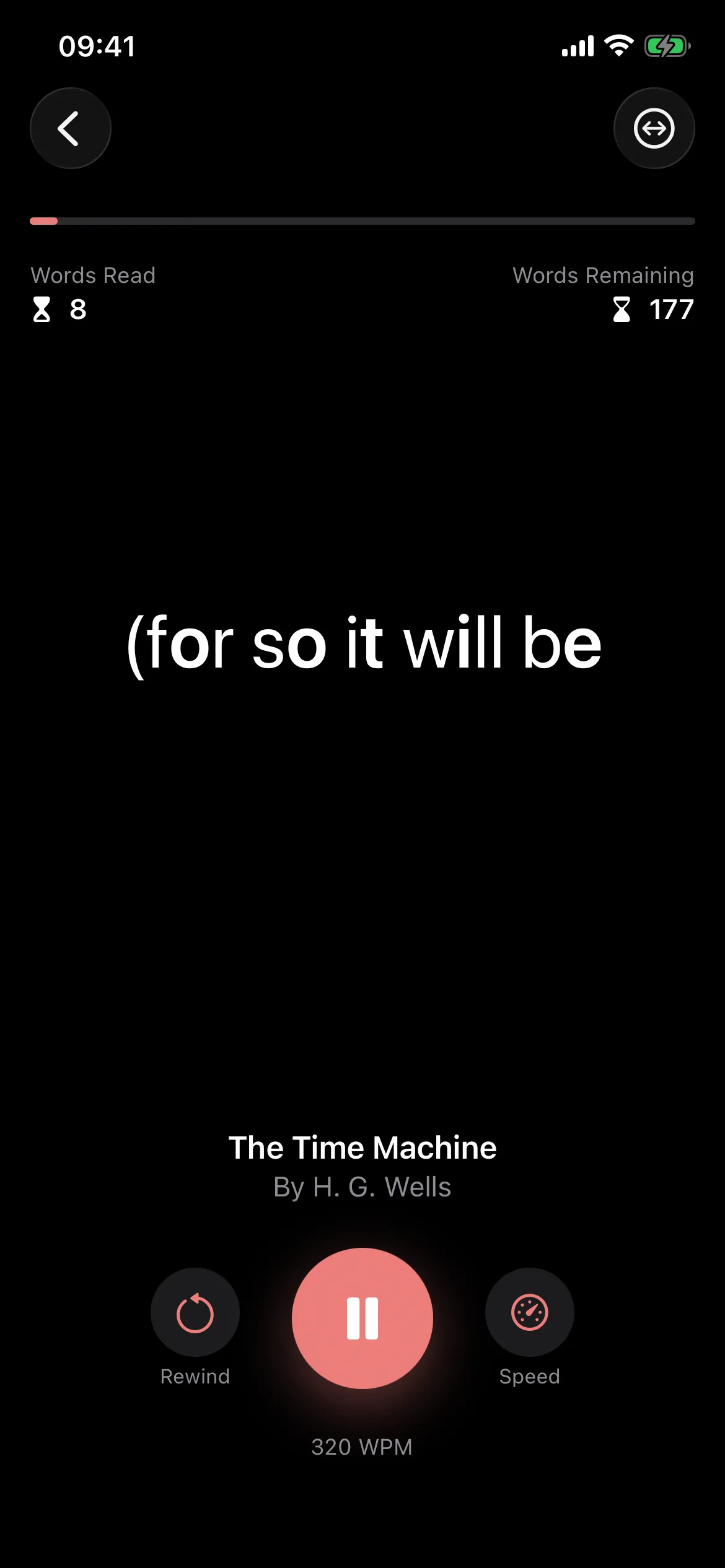
Flitread is an iPhone speed reader built around phrase-by-phrase pacing. Press play and it flashes your text one natural phrase at a time, with each word’s anchor letter subtly bolded to guide your eye. Timing is humane, not metronomic: longer phrases stay up longer, sentence ends breathe, and playback ramps gently back up after a pause.
- Import EPUB, PDF, DOCX, HTML, or plain text; paste anything; pull an article from a URL; or share to Flitread from Safari
- Per-book speed with a live words-per-minute readout
- Serif or sans reading typefaces, honest typography, no clutter
- Every book remembers its exact position, so nothing gets re-read by accident
- Fully offline, on-device and private: no account, your library never leaves your phone
- $3.99 once. No subscription, no ads
Demo text, the opening of Alice’s Adventures in Wonderland: Alice was beginning to get very tired of sitting by her sister on the bank, and of having nothing to do: once or twice she had peeped into the book her sister was reading, but it had no pictures or conversations in it, "and what is the use of a book," thought Alice, "without pictures or conversations?" So she was considering in her own mind (as well as she could, for the hot day made her feel very sleepy and stupid), whether the pleasure of making a daisy-chain would be worth the trouble of getting up and picking the daisies, when suddenly a White Rabbit with pink eyes ran close by her. There was nothing so very remarkable in that; nor did Alice think it so very much out of the way to hear the Rabbit say to itself, "Oh dear! Oh dear! I shall be late!" But when the Rabbit actually took a watch out of its waistcoat-pocket, and looked at it, and then hurried on, Alice started to her feet, for it flashed across her mind that she had never before seen a rabbit with either a waistcoat-pocket, or a watch to take out of it, and burning with curiosity, she ran across the field after it, and fortunately was just in time to see it pop down a large rabbit-hole under the hedge. In another moment down went Alice after it, never once considering how in the world she was to get out again. The rabbit-hole went straight on like a tunnel for some way, and then dipped suddenly down, so suddenly that Alice had not a moment to think about stopping herself before she found herself falling down a very deep well. Either the well was very deep, or she fell very slowly, for she had plenty of time as she went down to look about her.
The actual mechanic, running right here. On iPhone it does this with your own books, at whatever pace you choose.
The focus part
Speed gets the headline, but focus is the quieter benefit. When one phrase fills the screen, there is nothing else to look at: no wall of text waiting to discourage you, no paragraph whose length you can judge from across the room. The display moves at exactly the speed you chose, so your attention has one calm thing to follow.
We built this as a speed feature, and readers turned it into a focus feature. Many who describe themselves as easily distracted tell us the pacing keeps them anchored. We won’t claim it treats anything: it is a display choice, and you’ll know within a minute whether it works for you.
If reading isn’t just slow for you but genuinely tiring (small text, swimming lines, losing your place), there’s a separate page on reading with big text, one phrase at a time.
What fast reading can’t do
No method, including this one, turns 220 WPM into 1,000 WPM while you understand everything you read. Comprehension is the whole point of reading, and hype that ignores it is why speed reading has a sketchy reputation. What paced phrase reading does honestly well is remove overhead, which is how most readers reach up to 2–3× their normal pace with practice.
Some texts also deserve slow reading: poetry, contracts, anything you’ll argue with. Flitread gives every book its own pace, and pause is one tap. Fast is a setting, not a religion.
Find your starting point
Curious what your baseline is? The free reading speed test takes about two minutes and includes a comprehension check, so the number is honest. Then come back up and run the demo at your own pace.
Faster reading, honestly answered
Is speed reading actually real?
The ceiling is real, and so is the effort. Claims of 10,000 WPM are skimming with extra steps: no one reads ten books in an hour and remembers them. What paced phrase reading genuinely does is remove the mechanical overhead of eye movement and lost lines, which is how most readers comfortably reach up to 2–3× their starting pace with practice.
What is RSVP reading?
RSVP stands for rapid serial visual presentation: text shown in place, one segment at a time, so your eyes barely move. Older RSVP apps flashed a single word at a time at a fixed rhythm, which reads as frantic. Flitread shows natural phrases with humane timing instead: longer phrases stay up longer and sentence ends breathe.
How much faster can I realistically read?
Most adults read between 200 and 250 words per minute. With practice, Flitread readers comfortably reach up to 2–3× their starting pace. Faster settings exist and are fun to try, but comprehension is yours to manage, so treat the higher numbers as a sprint, not a cruising speed.
Will I still understand what I read?
Flitread is designed to preserve comprehension, not to promise improvements. You see every word; the app controls when, not whether. Phrases keep the units your brain already parses, so nothing arrives as chopped-up nonsense. Start at a pace that feels easy and raise it only when it stays easy.
How do I stay focused while reading?
Remove the choices. One phrase on screen, one place to look, a pace you set in advance. Readers who describe themselves as easily distracted tell us the pacing keeps them anchored, because the moving display gives the eyes a single calm thing to follow and a wandering mind nothing to bounce off.
What can I read with Flitread?
Books in EPUB, PDFs, Word documents, HTML and plain text files, anything you paste, readable articles from a URL, or anything you share to Flitread from Safari or another app. Kindle files are DRM-locked by Amazon and can’t be imported. Flitread is for iPhone, iOS 17 or later, a one-time $3.99 purchase with no subscription and no account.
Your reading list is not getting any shorter.
Flitread for iPhone: one phrase at a time, up to 2–3× faster with practice, $3.99 once.
$3.99 once · No subscription · No ads · iOS 17+